AEO for Business: How VisRank Helps You Win
Learn what businesses need to know about AEO, why answer engines choose certain sources, and how VisRank turns AI visibility gaps into fixes.
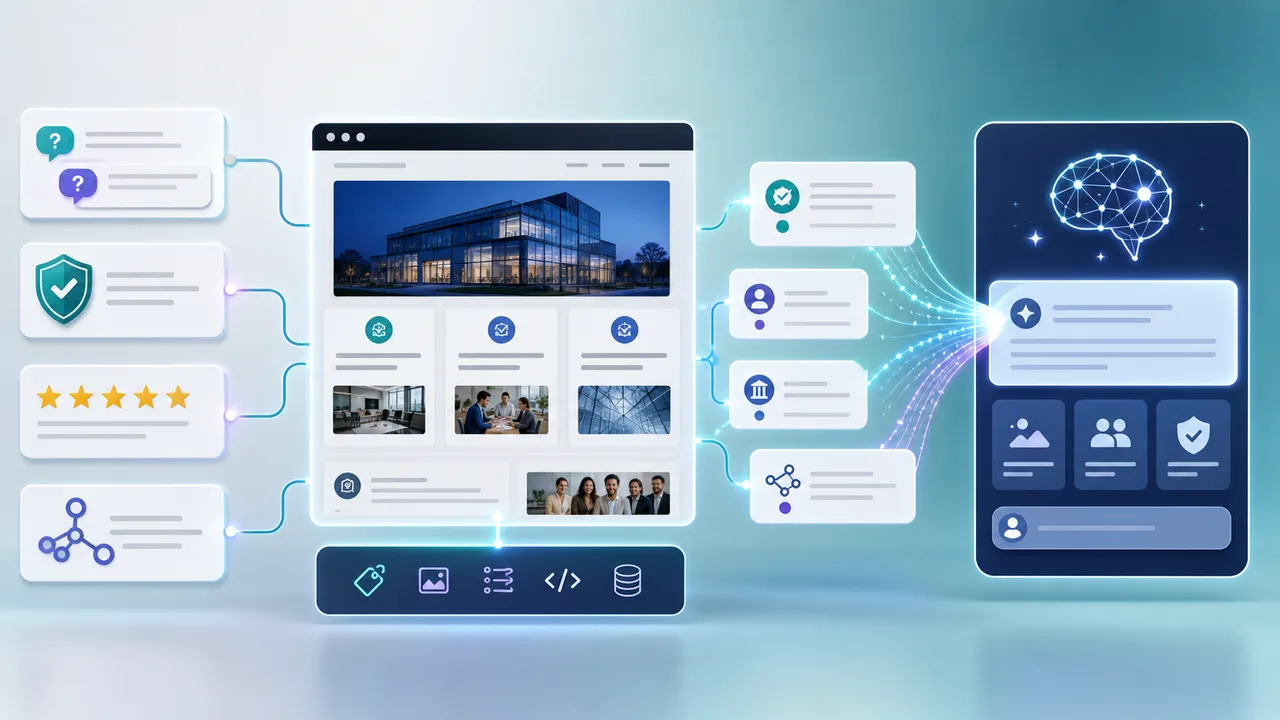
AEO helps businesses become the source an AI answer can trust. The goal is not just to rank a page. The goal is to make your business easy to understand, easy to quote, and easy to recommend when buyers ask answer engines for help.
Most companies still treat AEO like a technical add-on: add a few schema blocks, publish an FAQ, and hope AI search notices. That is too narrow. Answer Engine Optimization is really an operating system for clarity. It asks a harder business question: if an AI assistant had to explain what you do, who you serve, why you are credible, and what someone should do next, would your website give it enough clean evidence
This is the gap VisRank was built to expose. A traditional SEO report can tell you whether a title tag is missing. VisRank also checks whether your content is structured as an answer, whether your entity is clear, whether your schema supports the page, and whether AI crawlers can actually reach the information. That matters because buyers are no longer only searching with keywords. They are asking full questions.
What is AEO for a business
AEO for business is the practice of making your website usable as a source for AI-generated answers. It combines structured data, answer-first copy, entity clarity, author trust, fresh content, and internal links so answer engines can understand what your business knows and when to cite it.
If SEO helps your page appear in search results, AEO helps your business appear inside the answer. Those are related, but not identical. A page can rank and still be hard for an AI system to extract from. A page can be beautifully designed and still fail to explain the obvious things a buyer wants to know.
For the foundation, read our AEO definition guide. This article focuses on the business layer: how AEO changes the way companies should present expertise, proof, and conversion paths.
The answer-source model
A useful way to think about AEO is the answer-source model. Every page that wants AI visibility has to pass five checks before it deserves to be cited.
| Layer | Business question | What VisRank checks |
|---|---|---|
| Access | Can AI crawlers and search engines reach the page | Indexability, robots signals, canonical tags, sitemap coverage, AI crawler access. |
| Understanding | Can the system identify who you are and what the page is about | Organization schema, semantic headings, page title, entity clarity, structured data. |
| Extraction | Can the system lift a clean answer from the page | FAQPage, Q&A patterns, answer-first sections, lists, tables, step sequences. |
| Trust | Is there enough evidence to cite this business confidently | Author signals, freshness, contact details, local signals, security headers, content depth. |
| Action | If the answer creates interest, is the next step obvious | Visible CTA, internal links, page intent match, local/contact paths, report guidance. |
What businesses usually get wrong about AEO
The biggest mistake is treating AEO as a content volume problem. Publishing more articles does not help if each page hides the answer, uses vague headings, lacks schema, or never states the business entity clearly. AI systems reward extractable clarity more than word count.
The second mistake is separating brand trust from technical structure. A page with correct schema but no proof, no author, no freshness, and no useful details is still a weak source. A page with strong expertise but no machine-readable structure is also weak. AEO needs both.
- Vague headings. "Our approach" is harder to extract than "How does AEO help a SaaS business get cited in AI search"
- Buried answers. If the direct answer appears after six paragraphs, it may never be selected.
- Schema without visible support. JSON-LD should describe content users can actually see on the page.
- Weak entity signals. AI systems need a consistent business name, category, location or market, and proof of expertise.
- No conversion path. Being cited is useful only if interested buyers can quickly scan, trust, and act.
How VisRank helps businesses with AEO
VisRank turns AEO from a vague idea into a measurable checklist. The scanner reviews 49 signals across SEO, AEO, security, and local visibility, then separates what passed from what needs work. The AEO category includes 18 checks covering the signals answer engines rely on most.
That broad view matters. AI visibility is rarely blocked by one dramatic failure. It is usually a stack of small gaps: no FAQ schema, unclear headings, thin contact details, stale dates, missing Organization data, weak author identity, or a robots rule that makes discovery harder. VisRank shows those gaps in one place.
- It finds machine-readable gaps. VisRank checks JSON-LD, Organization, BreadcrumbList, FAQPage, HowTo, LocalBusiness, and other schema signals where relevant.
- It checks answer readability. The audit looks beyond tags and asks whether the page has Q&A patterns, semantic headings, and extractable answer blocks.
- It weighs AEO against business risk. A missing title, missing schema, and weak security header are not equal. VisRank prioritizes issues by impact.
- It connects AEO to SEO and trust. The same page may need better metadata, stronger schema, contact clarity, and security hygiene before it becomes a credible source.
You can see the full signal breakdown on the VisRank methodology page, or run the AI search audit to see how your own site performs.
What should a business fix first
Fix AEO in the order that removes the biggest blockers first: access, identity, extraction, proof, then conversion. This prevents the common mistake of polishing FAQ copy while the page still has no clear entity or crawl path.
| Priority | Fix | Why it matters |
|---|---|---|
| 1 | Make important pages indexable and canonical. | A page cannot be cited consistently if discovery and canonical signals are confused. |
| 2 | Add truthful Organization and page-level schema. | Structured data tells AI systems what the page and business represent. |
| 3 | Rewrite top sections with direct answers. | Answer engines need clean extractable passages, not only persuasive prose. |
| 4 | Add evidence: author, dates, contact, examples, and internal links. | Trust signals help distinguish a cite-worthy source from generic content. |
| 5 | Make the next action obvious. | AI visibility is a business channel only when interested users can move forward. |
How AEO changes content strategy
AEO does not mean writing for robots. It means writing in a way that removes ambiguity for both humans and machines. Good AEO pages are usually better human pages: clearer headings, faster answers, more specific proof, and fewer vague claims.
Instead of asking "How many keywords did we include", ask these questions:
- Can a buyer understand the answer in the first few sentences
- Can an AI system identify the business, topic, and page type from structured data
- Does each section answer one specific question
- Does the page show why this business is qualified to answer
- Does the page link to the next useful resource instead of ending abruptly
For practical implementation, pair this article with the AI search optimization guide and the AEO signals checklist.
The business case for AEO
The business case is simple: buyers are using answer engines to shortlist options, compare tools, understand problems, and decide what to investigate next. If your website is hard to cite, your competitors can become the explanation of your category before a buyer ever reaches your page.
AEO helps protect discovery in that environment. It improves the chance that your expertise is represented accurately, that your business is connected to the right category, and that your best pages can support both traditional search and AI-generated answers.
The fastest way to start is not a full rewrite. Start with measurement. Run a VisRank scan, fix the highest-impact AEO blockers, then update the pages that already matter most to your pipeline: homepage, service pages, pricing page, comparison pages, local pages, and the articles that answer buyer questions.
Key takeaways
- AEO is the business discipline of becoming a clear, trustworthy source for AI-generated answers.
- The strongest AEO pages pass five layers: access, understanding, extraction, trust, and action.
- VisRank helps by measuring AEO alongside SEO, security, and local signals instead of treating AI visibility as a separate guess.
- Businesses should fix crawl/index signals and entity clarity before polishing advanced content patterns.
- The best AEO work also improves human conversion because it makes pages clearer, more specific, and easier to act on.
Related articles
Check your website's SEO & AEO score
Free visibility audit - no signup required.
Scan my website for free