VisRank
Home
Free SEO CheckerSEO Audit ToolAEO CheckerAI Search AuditAI Citation Auditllms.txt GeneratorLocal SEO AuditTrust & Entity Audit
How it worksFeaturesPricingFAQBlogUpdatesContact
Free Scan
Transparent scoring

How VisRank scores websites

Every VisRank scan runs 49 core checks across 4 categories to calculate the Visibility Score (0–100). New scans also include separate Trust & Entity Visibility and AI Citation Readiness scores, so entity proof and citation readiness can improve without rewriting older score history.

The score formula
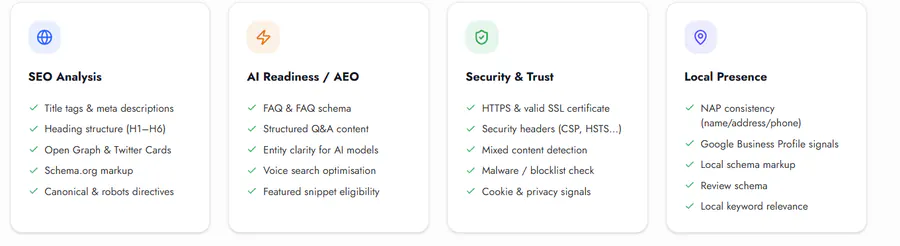
VisRank four audit categories: SEO Analysis, AI Readiness, Security and Trust, Local Presence with check items listed
Visibility Score =
SEO × 0.35+AEO × 0.25+Security × 0.25+Local × 0.15

Each category score is 0–100. The result is rounded to the nearest integer. Trust & Entity and AI Citation are reported separately and do not change this weighted formula.

Score thresholds

Excellent
80–100

Strong visibility. Keep monitoring for regressions.

Good
60–79

Solid foundation. A few improvements will push you into Excellent.

Average
40–59

Common issues are holding you back. Quick wins available.

Poor
0–39

Fundamental problems. Fixing the basics will have the biggest impact.

All 49 core checks explained

SEO

35% of overall score · 13 checks

Title tag — 30–70 characters. Too short = weak signal. Too long = truncated in SERPs.
Meta description — 120–160 characters. The click-through text in Google results.
H1 tag — Exactly one H1 per page. Missing or multiple = crawl confusion.
Canonical link — Prevents duplicate content penalties by declaring the preferred URL.
Robots.txt — Must exist and be accessible for proper crawl control.
Sitemap.xml — Helps Google discover all pages, especially new or deep ones.
Image alt text — Percentage of images with alt attributes — accessibility + SEO.
Mobile viewport — Required for Google mobile-first indexing.
HTTPS — Ranking signal since 2014. Also required for security score.
OpenGraph tags — og:title, og:description, og:image — controls social share appearance.
Language attribute — <html lang="en"> — helps Google serve the right language to users.
Twitter Card — twitter:card meta — controls X/Twitter link preview.
Noindex absence — A noindex tag on a live page blocks Google from indexing it entirely.

AEO

25% of overall score · 18 checks

JSON-LD presence — Any structured data schema. Enables rich results and AI extraction.
FAQPage schema — Makes visible Q&A content machine-readable. Google FAQ rich results are limited, so this is treated as an extraction and clarity signal rather than a guarantee.
Organization schema — Establishes entity identity. Used by AIs to describe your business.
LocalBusiness schema — Required for local AI answers and Google Maps integration.
Semantic headings — Minimum 2× H2s. AI engines use heading structure to extract answers.
Contact details — Phone, email, or address detectable in page content.
Entity clarity — Organisation name visible in page content — not just in code.
Q&A content — FAQ sections signal answer-rich content to AI crawlers.
BreadcrumbList schema — Navigation context for AI search and Google breadcrumb rich results.
HowTo schema — Marks up visible step-by-step content when it exists. Useful for machine readability, not a guaranteed Google rich result.
llms.txt — AI crawler guidance file that explains the site and key public pages.
AI crawler access — Checks robots.txt for blocks against GPTBot, ClaudeBot, PerplexityBot and related crawlers.
Content depth — Looks for enough visible text for AI systems to understand and cite the page.
Author schema — Person or author identity signals that support E-E-A-T and source attribution.
AI citability — Detects direct-answer patterns, definitions, statistics, and extractable lists.
Content freshness — Checks current-year references plus datePublished and dateModified schema signals.
Speakable content — Identifies speakable markup or page sections suitable for voice assistant answers.
Structured answer patterns — Finds tables, details blocks, comparisons, and numbered steps that AI systems can extract.

Security

25% of overall score · 10 checks

HTTPS — Encrypted connection. Required for user trust and a direct Google ranking signal.
HSTS — Strict-Transport-Security header. Forces HTTPS for repeat visitors.
Content-Security-Policy — Restricts where scripts can load from. Prevents XSS attacks.
X-Frame-Options — Prevents your site from being embedded in iframes (clickjacking protection).
Referrer-Policy — Controls what URL is sent in the Referer header when users navigate away.
Permissions-Policy — Restricts browser feature access (camera, mic, geolocation).
X-Content-Type-Options — Prevents MIME sniffing attacks. Simple header, high impact.
Mixed content — HTTP resources on HTTPS pages break the secure seal.
Server header leak — Server/X-Powered-By headers reveal your tech stack to attackers.
DNS-Prefetch-Control — Controls whether browsers can prefetch DNS for linked domains.

Local

15% of overall score · 8 checks

Location mentions — City/suburb/region detected ≥2 times in page text.
Phone number — Formatted phone number detectable in page content.
Street address — Physical address format (number + street name) in content.
LocalBusiness schema — Structured address, hours, and contact for Google Maps data.
Contact page link — Internal link to a /contact or contact page.
Google Maps embed — Embedded map confirms physical location to Google.
Opening hours — Hours in schema or page text — required for local pack results.
Review signals — Review count, star ratings, or Review schema present.

Separate scores for trust and AI citation

These layers are included in reports and Monitoring evidence, but they sit beside the core Visibility Score so older scans remain comparable.

Trust & Entity Visibility

14 verification checks

Measures whether search engines and AI systems can verify who is behind the site.

About page
Contact page
Privacy and Terms pages
Business name
Clear niche description
Email contact path
Phone or support path
Address or service area
Social profile links
sameAs schema
Organization schema completeness
Author, founder or team information
Google Business Profile consistency when relevant
Reviews, testimonials or proof signals

AI Citation Readiness

8 citation-readiness checks

Measures whether the page is easier for AI answer systems to extract, verify, and cite accurately.

Answer-first blocks
Extractable formats
Buyer-intent prompt coverage
Entity answer context
Source and proof signals
Machine-readable discovery
Freshness signals
Prompt coverage

This score does not guarantee inclusion in ChatGPT, Google AI Overviews, or Perplexity.

Methodology FAQ

Why does security get the same weight as AEO (25%)?

Google has used HTTPS as a ranking signal since 2014. Security headers are not Core Web Vitals metrics, but they are practical trust and technical-quality signals that protect users and reduce risk.

Why is Local only 15%?

Local SEO signals are critical for businesses with physical locations but irrelevant for SaaS or global products. If your business is local, treat Local as much higher priority than the weight suggests.

Does VisRank check page speed or Core Web Vitals?

Not directly. Page speed requires browser rendering (JavaScript, CSS cascade) which a single HTTP request cannot measure accurately. We recommend using Google PageSpeed Insights or Lighthouse for CWV testing. We may add speed signals in a future version.

How often should I re-scan?

After every significant content or tech change. Monitoring subscribers get weekly checks, change history, fix progress, score-drop alerts, and AI visibility alerts when important crawl, schema, canonical, noindex, llms.txt, or AI Citation signals regress.

Are scores compared to competitors?

Not in the base scan. Competitor tracking (side-by-side scores) is available in the monitoring plan.

See your score now

Run a free scan and see which core checks, Trust & Entity signals, and AI Citation signals your site passes or fails.

Scan my website free
About VisRankAI Citation AuditTrust & Entity AuditFree SEO CheckerSample Report
VisRank

Free website visibility audits. Check SEO, AI readiness, security & local presence in 30 seconds.

VisRank™ is the official SEO and AI readiness audit tool available at visrank.org.

general@visrank.org

Tools

  • Free SEO Checker
  • SEO Audit Tool
  • AEO Checker
  • AI Search Audit
  • AI Citation Audit
  • llms.txt Generator
  • Local SEO Audit
  • Trust & Entity Audit
  • WordPress SEO Audit
  • Shopify SEO Audit

Solutions

  • For Agencies
  • For Local Businesses
  • For Ecommerce
  • For SaaS
  • For Developers
  • For New Businesses

Resources

  • Blog
  • Case Studies
  • Examples
  • Sample SEO Report
  • Updates
  • FAQ
  • Pricing

Company

  • About
  • Methodology
  • Features
  • Comparisons
  • Contact
  • Privacy Policy
  • Terms of Service

© 2026 VisRank. All rights reserved. Auckland, New Zealand.

PrivacyTermsMethodology