Can ChatGPT Replace an SEO Audit? Two Live Tests
Can ChatGPT replace an SEO audit? Compare two dated live-site scans, visible evidence, fix priorities, and the VisRank post-deploy verification workflow.

ChatGPT can explain SEO and help implement changes. It does not, by default, replace a consistent website audit. The difference is instrumentation: VisRank starts with a live URL and a declared set of checks; a general AI assistant starts with a prompt and whatever access, tools, and context you give it.
The honest comparison is not “smart AI versus smart software.” VisRank itself uses AI for eligible saved fixes. The practical difference is the workflow around the model: capture a baseline, attach evidence to each issue, prioritize the work, deploy through an authorized person or tool, and scan again to see whether the live condition changed.
The answer in one sentence
Use an AI assistant to reason and help write the change; use VisRank to decide which observable website problem deserves attention and whether the deployed fix actually removed it.
Can ChatGPT really fix SEO problems
Sometimes, yes. OpenAI says ChatGPT can search the web and cite sources when search tools are enabled. Its agent mode can browse, work with files, use tools, and take actions under the user's control. A coding agent with repository access can edit a title, add schema, adjust a canonical, or configure a header. Pretending that modern assistants are only chat boxes would make this comparison useless.
Access is the boundary. OpenAI also warns that ChatGPT can produce confident but incorrect output, may be unable to access a website, and should be verified for important work. An assistant that cannot see the deployed response headers, rendered HTML, CMS state, CDN rules, or post-deploy page cannot prove that its proposed change reached production.
Sources: OpenAI on ChatGPT accuracy and tool access and OpenAI's ChatGPT agent overview.
What changes when the workflow starts with a live audit
| Task | General AI assistant | VisRank workflow |
|---|---|---|
| Starting input | A prompt plus supplied files, links, browser access, or repository access | A public URL evaluated with the same declared audit method |
| Diagnosis | Depends on the prompt, model, tools, accessible pages, and instructions | Issue records tied to observed page signals, categories, severity, and evidence |
| Implementation | Can explain, generate code, or edit when authorized and connected to the site or repo | Provides issue-linked steps and saved AI fixes for eligible paid-report issues |
| Deployment | Possible only with suitable access, permissions, and approval | Not automatic; the owner, developer, CMS operator, or authorized agent deploys the change |
| Verification | Requires a separate retest and a carefully preserved method | Monitoring repeats the scan, records change history, and surfaces fixed, open, new, or returning issues |
Two live tests: the disclosed method
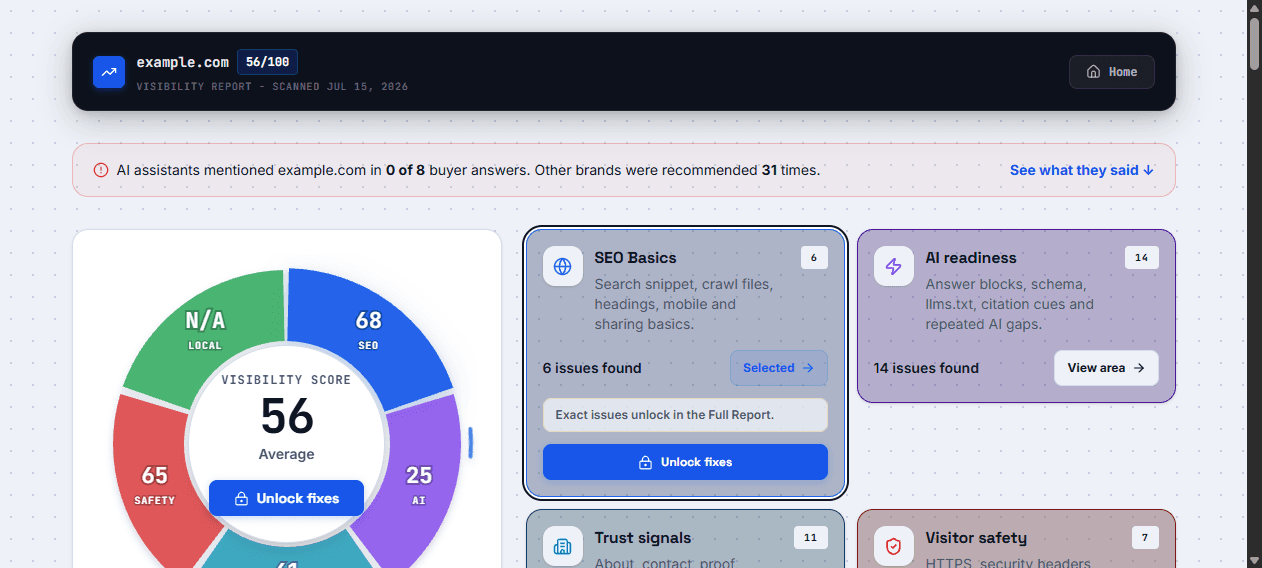
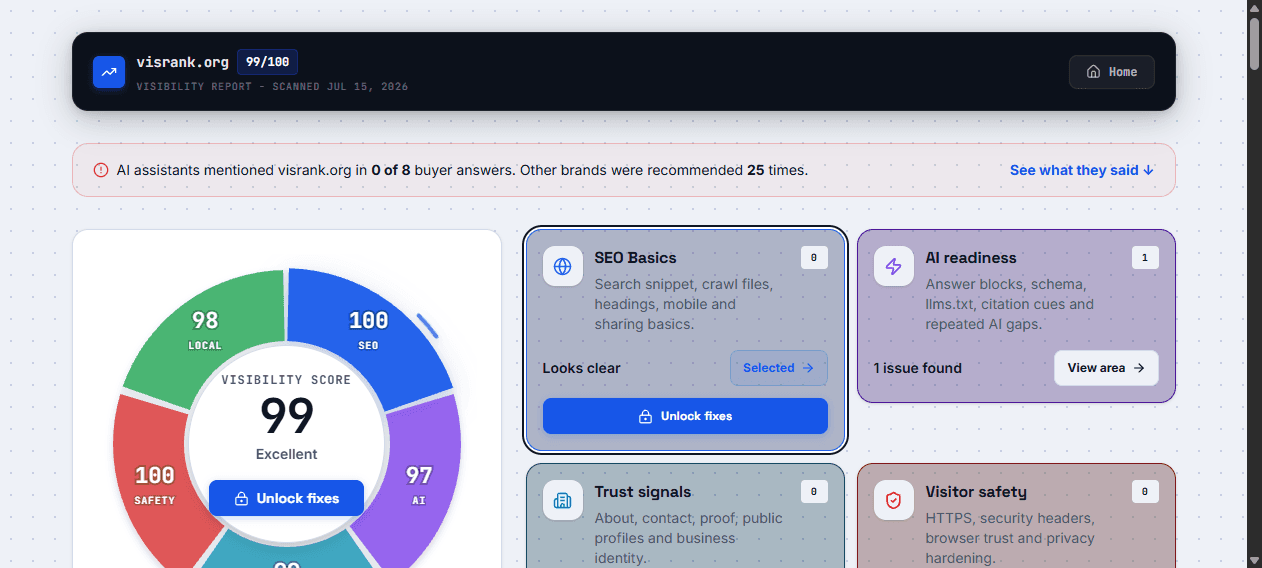
We scanned two public URLs with the VisRank public workflow on July 15, 2026. The first was example.com, a reserved example domain intentionally kept minimal by IANA. The second was visrank.org, VisRank scanning its own site. Both choices have limitations, so the screenshots and numbers are shown instead of being turned into a customer success claim.
- Same date and workflow: both captures use the public scan interface on July 15, 2026.
- Observable output: category scores and visible issue counts are recorded in the screenshots below.
- No ranking claim: a VisRank score is a diagnostic result under the VisRank methodology, not a Google score, traffic forecast, or AI-citation probability.
- No independent benchmark claim: the VisRank self-scan is useful for showing the same instrument on a maintained site, but it is not third-party validation.
Test 1: example.com exposes site-specific gaps
The scan returned 56 overall, 68 for SEO, 25 for AI readiness, 41 for Trust, and 65 for Safety. The visible cards recorded 6 SEO issues, 14 AI-readiness issues, 11 Trust issues, and 7 Safety issues. Local was not applicable. That pattern makes sense for an intentionally minimal example page; it is useful as a control, not as a normal business benchmark. IANA explains the purpose of these reserved domains in its example-domain guidance.
Test 2: the same scan applied to visrank.org
The self-scan returned 99 overall, 100 for SEO, 97 for AI readiness, 99 for Trust, 100 for Safety, and 98 for Local. The visible cards showed no SEO, Trust, or Safety issues and one AI-readiness issue. The useful point is not that the vendor scored itself highly. It is that the same workflow produced a different, inspectable category profile from a different deployed site.
Score comparison from the two captures
The chart below transcribes the visible scores from the screenshots. It shows the instrument producing different findings; it does not measure search rankings, traffic, or ChatGPT's ability.
What the tests prove, and what they do not
Supported by the evidence
- VisRank records a dated, category-level baseline from a public URL.
- The output changes with observable conditions on different sites.
- Issue counts can be attached to screenshots, fix guidance, and later rescans.
- A website owner can preserve the before state instead of relying on a chat transcript alone.
Not supported by the evidence
- That ChatGPT could not inspect either page when given the right tools.
- That a higher VisRank score guarantees rankings, clicks, revenue, or AI citations.
- That the self-scan is independent product validation.
- That every detected issue should be fixed without human review.
What VisRank adds beyond a strong prompt
- A fixed starting point. The URL, scan date, score breakdown, issues, and evidence become a baseline that can be revisited.
- Cross-category checks. The current product runs 49 core checks: 13 SEO, 18 AEO, 10 Security, and 8 Local, with separate Trust and Entity plus AI Citation evidence. See the live feature breakdown.
- Issue-linked output. The Full Report connects each finding to an explanation, steps, and saved AI fixes for eligible issues instead of asking the user to invent the next prompt.
- A verification loop. Monitoring rescans the live site and records whether an issue was fixed, stayed open, appeared, or returned after another change.
- Explicit limits. VisRank does not claim that its score is a Google ranking factor or that a fix guarantees traffic or an AI citation.
Google's own documentation is why live verification matters. Crawl access, robots directives, canonicalization, JavaScript rendering, metadata, and HTTP behavior can all affect whether Google can find and parse a page. These are deployed conditions, not just writing suggestions. Review the Google Search Central crawling and indexing documentation.
The strongest workflow uses both
- Scan the live URL. Establish the dated baseline and inspect the evidence, not only the total score.
- Choose the first issue. Prioritize access, indexability, canonical, security, and visible-data conflicts before cosmetic optimization.
- Use the right implementer. Apply the change through your CMS, developer, hosting provider, or an AI coding assistant with explicit repository and deployment access.
- Review before deployment. Check that schema matches visible content, security headers fit the application, and generated copy does not invent facts.
- Rescan production. A passing code review is not proof that a CDN, plugin, cache, build, or deployment exposed the expected result.
- Monitor regressions. Keep the method and history stable enough to catch a noindex tag, missing schema, broken canonical, or removed header when it returns.
When to use ChatGPT, VisRank, or both
| Need | Best starting point |
|---|---|
| Explain a concept, review code, draft a safe change, or compare implementation options | A capable AI assistant or developer |
| Get a fast, consistent baseline across public SEO, AEO, security, local, trust, and citation-readiness signals | VisRank |
| Turn a measured issue into an approved code or CMS change | VisRank evidence plus an authorized assistant, developer, or site operator |
| Prove the deployed condition changed and catch it if it returns | VisRank rescan and Monitoring |
Quick FAQ
Can ChatGPT perform an SEO audit?
ChatGPT can explain SEO, search the web, inspect supplied evidence, and sometimes use browser or coding tools. A reliable audit still needs a defined check set, access to the live site, recorded evidence, and a repeatable verification step.
What does VisRank do differently from a general AI assistant?
VisRank starts with a public URL and applies a consistent audit method across SEO, AEO, security, local, Trust and Entity, and AI Citation evidence. It connects findings to fix guidance and can rescan monitored sites to verify whether issues disappear or return.
Does VisRank automatically change a website?
No. VisRank diagnoses public signals and provides issue-linked steps plus saved AI fixes for eligible paid-report issues. A site owner, developer, CMS operator, or authorized coding agent still needs to review, deploy, and validate the change.
Should I use ChatGPT and VisRank together?
Yes. Use VisRank to establish the baseline, evidence, and priorities; use an AI assistant or developer to help implement approved changes; then rescan the live site to verify the result.
Start with evidence, then ask AI to help
Run the free SEO checker to capture the current public state. If you want the full audit scope and limitations before acting, read the VisRank methodology. Then take the exact issue and evidence to your developer, CMS, hosting provider, or preferred AI assistant. The prompt becomes specific, the change becomes reviewable, and the rescan supplies the proof.
Related articles
Check your website's SEO & AEO score
Free visibility audit - no signup required.
Scan my website for free