Fix Zero-Click SEO When Clicks Drop
Ranking and impressions can rise while clicks fall. Learn why zero-click SEO happens and how to win visibility in AI-heavy search results.
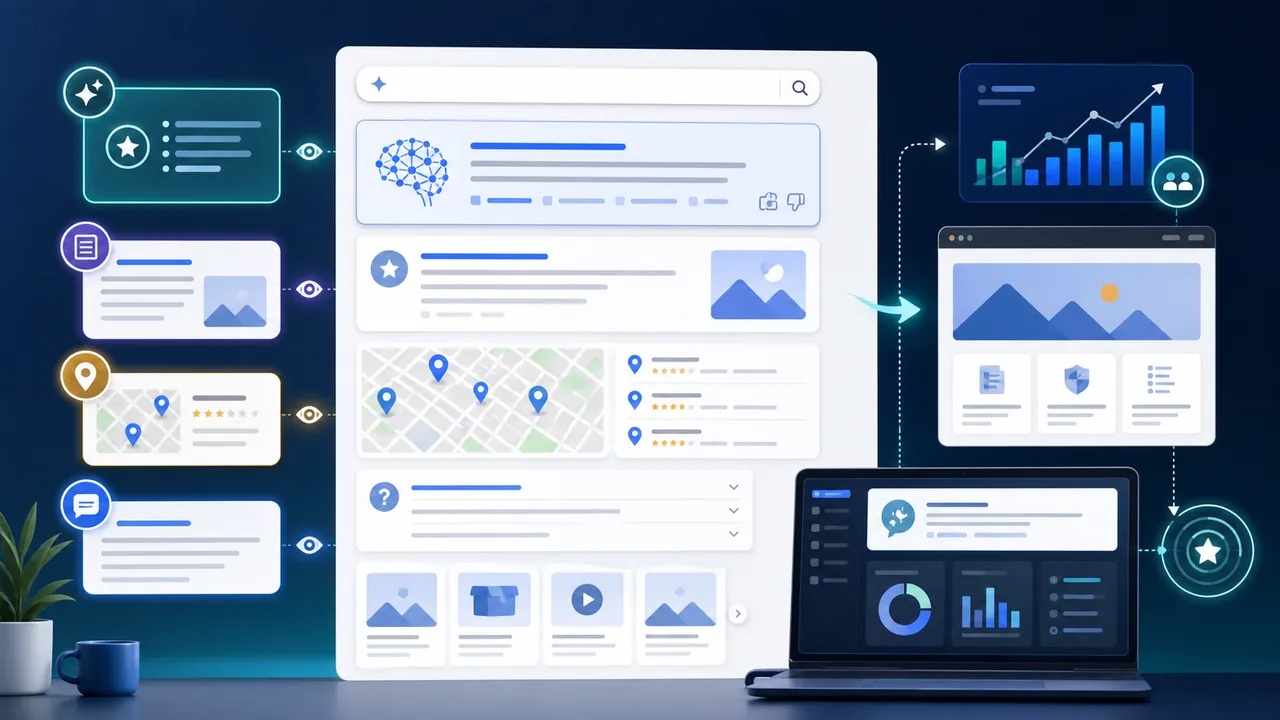
You are ranking on Google and impressions are growing, but clicks are falling. Zero-click search may be part of the explanation, but first separate it from position changes, weaker snippets, demand shifts, tracking issues, device mix, and other SERP features.
What is zero-click search
A zero-click search is any search that ends on the Google results page - no website visited, no link clicked. The user typed a query, got an answer from Google directly, and left satisfied. Your page may have been the source of that answer. You received zero traffic for it.
Zero-click results include AI Overviews, featured snippets, knowledge panels, direct answer boxes, local packs, calculators, and definitions. In 2026, these cover a broad and growing share of all query types - especially informational and how-to searches.
Why fewer searches follow the old click path
Search result pages can resolve some tasks with snippets, maps, calculators, product modules, knowledge panels, and AI-generated summaries. Other queries still require users to visit websites, compare sources, transact, or read deeper guidance.
AI Overviews can synthesize information and link to supporting sources. Their presence can change click behavior, but the impact varies by query, layout, device, market, and whether the user needs more detail.
Treat this as a measurement problem. Check whether the feature actually appears for the queries that lost clicks instead of assuming every decline is caused by AI search.
The scale of the problem: many searches end without a click
Zero-click search means users often get enough information from the results page, AI summary, local pack, or featured result before visiting a website.
Let that sink in before looking at your analytics:
- Some queries can be satisfied directly on the result page
- A strong ranking does not guarantee the same CTR across different SERP layouts
- Healthy impressions can coexist with weaker clicks for several reasons
Because result layouts change, compare your own Search Console and live-SERP evidence over time instead of relying on one universal zero-click percentage.
Why your traffic feels "fake" (impressions up, clicks down)
The disconnect between impressions and clicks is the defining SEO symptom of 2026. Here is what is happening in practice:
| What you see in GSC | What it actually means |
|---|---|
| Impressions rising | Your page is eligible to appear, but demand, position, query mix, or SERP layout may have changed |
| CTR falling | Check title, description, position, intent, device, country, competing features, and brand recognition |
| Rankings unchanged | Average position may hide movement, or another feature may have changed attention and click depth |
| Traffic declining | Confirm analytics and tracking, then isolate the affected queries and landing pages |
Related: why your SEO traffic dropped in 2026 - a deeper look at diagnosing the exact cause.
How AI search engines changed the rules
The shift from traditional search to AI-powered search is not incremental - it is a change in the fundamental contract between search engines and websites. The old model:
- Old rule: rank high, the user visits your site, and you get traffic
- New reality: rank well, be structured, be easy to summarize, and accept that the user may or may not click
AI tools - Google AI Overviews, ChatGPT, Perplexity, Microsoft Copilot - now summarise content, combine multiple sources, and deliver one synthesised answer. The search is no longer "find a website." It is "get an answer."
This is why AEO (Answer Engine Optimization) has become a useful discipline alongside traditional SEO. SEO helps you get discovered and indexed. AEO helps your content become easier to extract, verify, and use as a source.
The 3 new SEO rules for 2026
Rule 1 - You must be the source, not just a page
Ranking on page one used to mean traffic. In 2026, it often means eligibility to be seen in more complex result pages. The next step is making the page clear enough to be summarized, trusted, and credited when answer features appear.
To be considered as a source, your content must be clear enough for an answer system to extract a direct, accurate answer. That requires helpful visible content, supported structured data, entity clarity, and answer-first formatting - not just keyword relevance.
Rule 2 - Structure supports relevance
Keyword density is not a useful target. A page still needs relevant, helpful information, while clear headings, direct answers, and supported schema can make that information easier to understand and reuse.
Concise sections, lists, tables, and step sequences can improve scanning when they suit the question. They are formats, not substitutes for expertise, evidence, or complete coverage.
| Old SEO content | AI-optimised content |
|---|---|
| Dense paragraphs with keywords | Q&A format with direct answers first |
| Long-form prose to hit word count | Concise answers (40-60 words) + supporting detail |
| Vague section headings | Question-based H2s matching real user queries |
| No machine-readable context | Page-appropriate Article, Organization, Product, LocalBusiness, or BreadcrumbList JSON-LD |
| Written for Google crawlers | Written for humans, structured for machines |
Rule 3 - Authority beats optimization
Trust and technical quality solve different problems. Google describes E-E-A-T as a quality concept, with trust at its center, not as one measurable ranking factor or a universal penalty checklist.
Keyword stuffing is not just ineffective - it is a flag. Genuine expertise, real examples, specific data, and consistent entity signals are what build the authority that AI models select as sources.
What actually works in 2026
Answer-first content
Write every section as if you are answering a direct question. State the answer in the first sentence. Then expand with context, examples, and supporting detail. This is one of the highest-impact format changes for making content easier to extract and reuse accurately.
Topic clusters, not isolated posts
Related articles can help users and crawlers navigate a topic when each page serves a distinct intent. Publishing a fixed number of posts does not create authority by itself; depth, originality, evidence, and useful internal links matter more.
See how this works in practice: the AI search optimisation guide and the SEO vs AEO comparison are both part of the same cluster - covering different angles of the same core topic.
AI visibility tracking
Keep rankings, impressions, clicks, conversions, and revenue as core metrics. Add repeatable prompt and citation observations where they matter, while recognizing that AI answers vary and do not provide a standardized citation-rate metric.
Clear, extractable structure
Use one clear visual main title, descriptive section headings, direct answers where appropriate, and structured data that matches visible content. Use tables and steps when they genuinely help the reader.
Zero-click SEO action checklist
Use these steps to adapt your content strategy for the zero-click era:
Add AI visibility without replacing business metrics
AI mentions and citations can be useful observations, but they should sit beside clicks, qualified visits, conversions, revenue, branded search, and customer acquisition.
Record whether your brand appears for a stable set of important prompts, which source URLs are cited, and how competitors are represented. Then connect those observations to measurable site and business outcomes.
Avoid turning one manual chatbot result into a KPI. Answers vary by wording, time, location, model, and personalization.
Check your AI search visibility now
VisRank checks AEO readiness, structured data, entity signals, content structure, SEO fundamentals, security headers, and local presence. It prioritizes source-readiness gaps but does not calculate or promise an AI citation rate.
Key takeaways
- Zero-click search means ranking does not guarantee traffic
- Impressions rising + CTR falling means you should check rankings, snippets, SERP features, and AI Overviews before choosing a fix
- Google uses your content to answer questions without sending users to you
- The 3 new rules: be the source, structure beats keywords, authority beats optimization
- Answer-first content, clear entities, and supported schema are high-impact changes you can make today
- Track AI mentions as an additional observation, not a replacement for clicks, conversions, and revenue
- SEO remains the foundation for discovery, eligibility, relevance, and measurable organic performance
Frequently asked questions about zero-click SEO
What is zero-click SEO
Zero-click SEO refers to the strategy of optimising content to appear inside Google's on-page features - AI Overviews, featured snippets, knowledge panels - where users get their answer without clicking any link. In a zero-click world, visibility and brand citation matter more than raw click-through traffic.
Why are my Google impressions up but clicks down
This pattern can come from lower positions within the query set, weaker snippets, changed demand, device or country mix, seasonality, tracking, or richer result features. Check Google Search Console and the live results before confirming zero-click as the cause.
Can you still grow organic traffic in 2026
Yes. Build useful pages for queries that require depth, tools, comparison, local action, or transactions; improve snippets and internal links; and measure conversions. AEO can improve answer readiness, but it does not replace demand creation or traditional SEO.
What is the difference between SEO and AEO
SEO (Search Engine Optimization) focuses on ranking your pages higher in traditional blue-link results. AEO (Answer Engine Optimization) focuses on getting your content cited as the answer in AI-generated responses - Google AI Overviews, ChatGPT, Perplexity. In 2026, both are required. Our SEO vs AEO guide covers this in detail.
How do I get my content included in Google AI Overviews
The three highest-impact tactics are: (1) add visible answer-first Q&A sections to key pages, (2) restructure content with question-based H2 headings and direct answers in the first sentence of each section, and (3) strengthen E-E-A-T signals - author credentials, specific data, consistent entity information. Our full guide to AI search optimisation walks through all ten steps.
Related articles
Check your website's SEO & AEO score
Free visibility audit - no signup required.
Scan my website for free