Fix AEO and SEO for Australian Regional Businesses
Fix Australian AEO gaps with stronger regional pages, entity trust, local SEO, schema, FAQs, and AI search readiness for small and national brands.
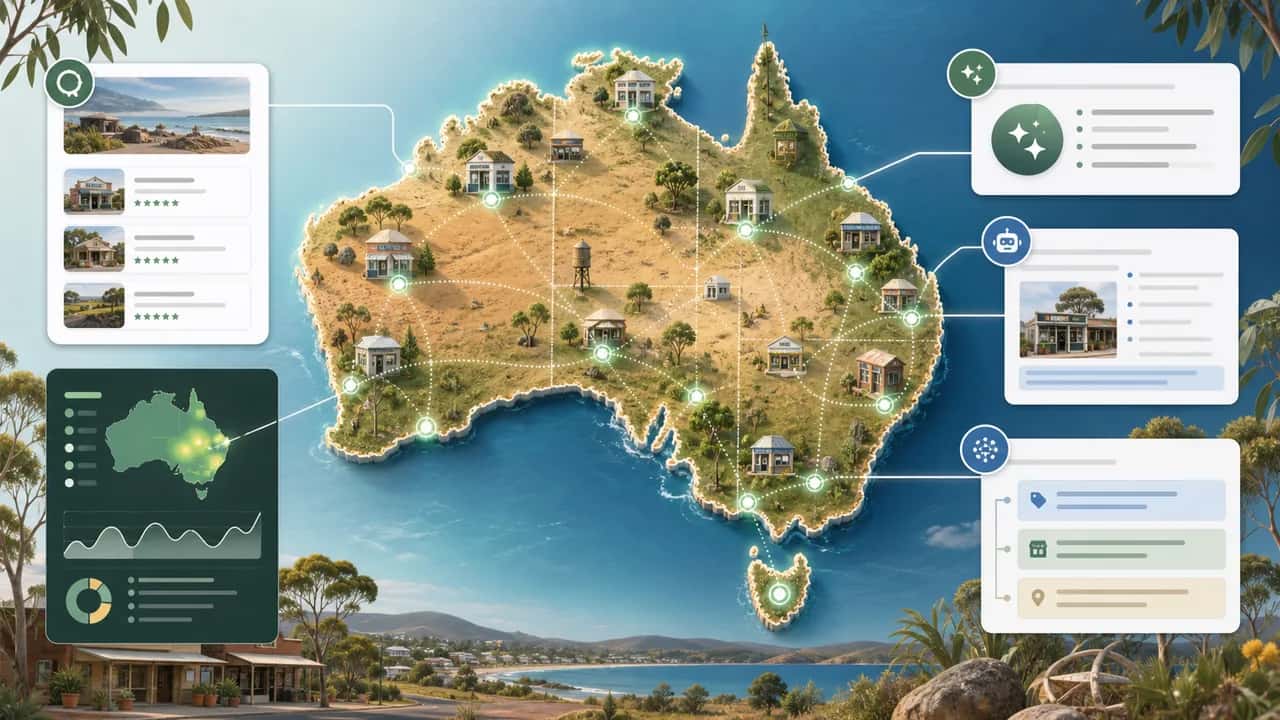
Australian search is becoming an answer market, not just a ranking market. A customer in Parramatta, Ballarat, Cairns, Geelong, Toowoomba, Newcastle, Perth, or regional WA may not click ten blue links first. They may ask Google AI features, ChatGPT, Perplexity, Gemini, or a voice assistant which business can solve the problem near them.
That changes the job of SEO. Ranking still matters, but the bigger question is whether an answer engine can understand the business, the region, the service, the proof, and the next step quickly enough to include you in the answer. That is where AEO - Answer Engine Optimization - becomes practical for Australian businesses of every size.
Short answer
AEO for Australian businesses means making your website easy to crawl, verify, summarize, and cite for Australian buyer questions. The strongest pages combine normal SEO foundations with clear regional coverage, Google Business Profile consistency, LocalBusiness or Organization schema, answer-first FAQs, visible trust proof, and current information.
Why Australia needs an AEO-first SEO strategy
Australia is not one neat search market. The Australian Bureau of Statistics reported 2,729,648 actively trading businesses at 30 June 2025, with data available down to states, territories, SA2 areas, and Local Government Areas in its Counts of Australian Businesses release. That means visibility competition is not only "Australia SEO". It is suburb, region, industry, and service-area competition.
The same ABS release also shows why the small-business angle matters: in 2024-25, 91.5% of Australian businesses had turnover below $2 million, and the number of non-employing businesses increased. In plain English: most Australian businesses do not have a large marketing team to manually explain their business across every search and AI surface. Their website has to do more of that work.
This is exactly where AEO helps. A smaller local business can lose in traditional authority, but win on clarity. If your pages state the answer quickly, show the region you serve, use consistent business details, and provide verifiable proof, you give answer systems cleaner material than a larger competitor with vague service pages.
SEO gets you found. AEO gets you understood.
SEO still handles the basics: crawlability, indexing, titles, internal links, speed, content quality, canonical URLs, and local relevance. AEO adds a second layer: can a machine extract a confident answer from the page and connect that answer to a real Australian business?
| Question | SEO answer | AEO answer |
|---|---|---|
| Can Google discover the page? | Sitemap, internal links, indexable HTML. | The page is also clear enough to summarize and cite. |
| Can it rank locally? | Location page, title, GBP, reviews, links. | The service area, proof, and answer are explicit. |
| Can an AI answer use it? | Not always measured by normal SEO checks. | Question headings, direct answers, schema, dates, and entity signals support extraction. |
| Can a buyer trust it? | Brand, reviews, content quality. | About, Contact, ABN or business identity where appropriate, profiles, testimonials, and public proof are easy to verify. |
Google says pages can appear as supporting links in AI features when they are indexed and eligible to show a snippet, and that site owners can control what appears with normal preview controls such as nosnippet, max-snippet, and noindex in its AI features documentation. The practical takeaway is simple: if your page is blocked, thin, vague, or not snippet-friendly, AEO has no foundation.
The real problems Australian sites have
The weakest Australian SEO/AEO pages usually do not fail because the business is bad. They fail because the page makes a search engine guess. These are the problems VisRank looks for when auditing business sites.
1. Regional pages are cloned, not useful
A page for "SEO agency Brisbane", "SEO agency Gold Coast", and "SEO agency Sunshine Coast" cannot be the same page with the city swapped. AI systems and users need proof that you actually serve that region: services available there, local examples, travel or remote delivery details, suburb coverage, local FAQs, and a clear next step.
2. The business entity is unclear
Many sites say "we" everywhere but never define the business clearly. Answer engines need an entity: business name, category, location or service area, contact path, founder or team context where relevant, profiles, and proof. This is why Trust and Entity SEO is not cosmetic. It tells machines and humans who stands behind the page.
3. Google Business Profile and website details drift apart
Google's own Business Profile guidance says local results are mainly based on relevance, distance, and prominence, and that complete business information helps Google match a profile to relevant searches. It also points to reviews, helpful replies, links, and ratings as prominence signals in its local ranking guidance. If your profile says one category, your website says another, and your regional page hides the actual service, both SEO and AEO become weaker.
4. The page answers marketing questions, not customer questions
AEO works best when headings match real customer questions: "Do you service regional Victoria", "How much does a building inspection cost in Perth", "Can you help a small Shopify store in Adelaide", or "What documents do I need before booking". If the page only says "premium solutions" and "tailored service", there is nothing concrete to extract.
5. Schema exists but does not match the visible page
Google explains that structured data gives explicit clues about a page, but also warns not to add structured data about information that is not visible to users in its structured data introduction. Schema is not magic. It is a label for real content. If your page has no visible address, service area, opening hours, pricing context, FAQ, or proof, markup alone cannot make the business trustworthy.
AEO priorities by Australian business type
| Business type | Most common gap | AEO fix |
|---|---|---|
| Small local service business | Thin service pages and inconsistent NAP details. | Create one strong service-area page with clear answers, GBP consistency, LocalBusiness schema, reviews, and suburb coverage. |
| Regional business | Pages mention the region but do not prove local relevance. | Add region-specific services, delivery constraints, local proof, regional FAQs, and internal links from nearby service pages. |
| National Australian brand | The site has authority but weak answer extraction. | Add answer-first sections, comparison content, stronger Organization schema, author/reviewer context, and current dates. |
| Multi-location business | Location pages compete with each other or use duplicated copy. | Give each location a unique purpose, map, services, staff or proof, parking/access details, reviews, and canonical consistency. |
| Ecommerce or SaaS in Australia | The page ranks for product terms but does not answer buyer research prompts. | Add comparison answers, product/service schema where appropriate, shipping or support details, Australian pricing context, and trust proof. |
What a strong Australian AEO page includes
A useful regional or national page should be built for extraction, not only persuasion. The page should let a user or AI system answer: who is this, what do they do, where do they do it, who is it for, why should I trust it, and what is the next step?
- A direct opening answer. The first section should name the service, audience, and region in plain language.
- Consistent entity details. Use the same business name, category, contact details, and service area across the site, GBP, citations, and schema.
- Regional specificity. Mention suburbs, LGAs, delivery limits, office or service-area reality, and state-specific context only when true.
- Visible proof. Add reviews, testimonials, case studies, memberships, certifications, public profiles, or project examples that a reader can verify.
- Question-led sections. Use real questions as H2 or H3 headings and answer them in the first sentence under the heading.
- Appropriate structured data. Use LocalBusiness for a real local branch or physical business, Organization for broader brands, and FAQPage only when the visible page contains the same questions and answers.
- Freshness and ownership. Show updated dates for advice pages, author or business ownership context, and links to About and Contact pages.
Real questions Australian customers ask
These are the kinds of questions your site should answer directly if you want to be useful in both search results and answer engines.
Do you service my suburb or region?
Answer with suburb, LGA, city, state, remote availability, and any travel limits.
Are you a real Australian business?
Show business identity, contact details, About page context, profiles, reviews, and visible proof.
How quickly can you help?
Give realistic booking, delivery, or response windows. Do not hide everything behind a form.
What does it cost in Australia?
Give ranges, examples, plan context, or explain what changes the price.
What makes you different from nearby competitors?
Use concrete proof: specialization, service coverage, experience, reviews, guarantees, or process.
Can I trust the advice?
Cite official sources, explain limitations, show author or reviewer context, and keep claims current.
How to fix an Australian site for AEO
Start with evidence, then rewrite. The wrong move is publishing fifty thin suburb pages because AI search is fashionable. The right move is auditing what answer systems can already understand and fixing the blockers in order.
- Check indexability and snippets first. If Google cannot index or preview the page, AI features have a weak base.
- Compare website details with Google Business Profile. Match category, services, location or service area, phone, URL, and business name. Read the deeper Google Business Profile SEO guide if local visibility is weak.
- Audit regional pages for uniqueness. Every important city, suburb, or region page should justify why it exists.
- Add answer-first blocks. Put direct answers under question-style headings before longer explanation.
- Validate schema against visible content. Use JSON-LD where possible, but make sure the facts are also on the page.
- Strengthen entity proof. Link About, Contact, public profiles, reviews, and proof pages together so the business is easier to verify.
- Publish and notify responsibly. Update your sitemap. For Bing and other participating engines, IndexNow supports URL submission when content is added, updated, or deleted, but its documentation says a 200 response means the URL was received, not guaranteed indexed.
Where VisRank fits
VisRank is built for this exact problem: a normal SEO audit is not enough when buyers are asking answer engines for recommendations. Start with the AEO checker to find answer-readiness issues, then use local landing page SEO and LocalBusiness schema guides to fix the regional layer.
If your issue is that AI tools mention competitors but not your business, read why ChatGPT does not mention your business. If you need reporting instead of a one-off fix, use the LLM visibility report guide to track prompts, citations, competitors, and fix progress.
Quick FAQ
What is AEO for Australian businesses?
AEO is the work of making your website easy for AI answer systems and search engines to understand, verify, and cite for Australian customer questions. It includes crawlability, schema, regional clarity, trust proof, and answer-first content.
Do small Australian businesses need AEO?
Yes. Small businesses often have less authority than national competitors, so clarity matters more. A clean local page with real answers, consistent details, reviews, schema, and proof can be easier for answer systems to use.
Should I create pages for every Australian suburb?
Only when each page has a real purpose and unique local value. Thin suburb pages with swapped names are risky and unhelpful. Build pages for regions where you can show true service coverage, proof, and useful local answers.
Does schema guarantee AI search visibility?
No. Schema helps systems understand the page, but it must match visible content and sit on top of crawlable, useful, trustworthy pages. It supports AEO; it does not replace content or proof.
Key takeaways
- Australian SEO is regional, entity-driven, and increasingly answer-led.
- AEO matters because AI search needs extractable answers, not only ranked pages.
- Small and regional businesses can compete by being clearer, more specific, and easier to verify.
- The biggest gaps are cloned regional pages, inconsistent business details, weak proof, and schema that does not match visible content.
- No one can guarantee AI citations. The honest goal is to remove blockers, improve answer quality, and monitor visibility over time.
Related articles
Check your website's SEO & AEO score
Free visibility audit - no signup required.
Scan my website for free